 English
 Tiếng Việt

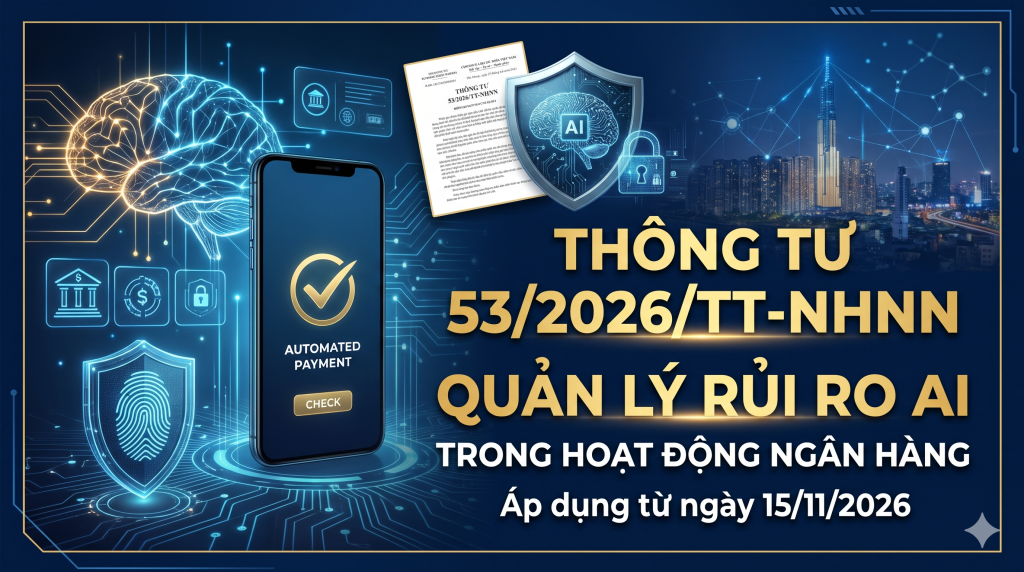
OFFICIAL TIGHTENING OF AI SYSTEM RISK MANAGEMENT IN THE BANKING SECTOR EFFECTIVE NOVEMBER 15, 2026
Effective November 15, 2026, Circular No. 53/2026/TT-NHNN, issued by the Governor of the State Bank of Vietnam (SBV) on September 30, 2026, officially enters into force. This landmark legal instrument establishes the safety framework, risk management protocols, and deployment conditions for Artificial Intelligence (AI) systems across credit institutions, foreign bank branches, intermediary payment service providers, Mobile Money service providers, and credit information companies.
Below are the core regulations that banking-finance institutions and customers must take into special consideration:
1. Classification of High-Risk AI Systems Based on Transaction and Lending Thresholds
Pursuant to Article 4 of Circular 53/2026/TT-NHNN, an AI system that automatically executes payment transactions or makes credit-granting decisions is classified as a high-risk AI system if it falls under any of the following scenarios:
-
For Individual Customers: Automatically executing a single transaction exceeding VND 10 million or reaching a cumulative daily transaction value exceeding VND 20 million.
-
For Institutional Customers: Automatically executing a single transaction exceeding VND 50 million or reaching a cumulative daily transaction value exceeding VND 100 million.
-
Lending Operations: Automatically making lending decisions for amounts of VND 50 million or more.
(Note: These thresholds also apply when an AI system executes multiple smaller transactions whose cumulative daily total exceeds the specified limits. These figures serve strictly to classify risk tiers for bank supervision and do not restrict manual transfer limits performed directly by users on banking applications).
2. Maximum Daily Caps on AI-Executed Automated Payment Transactions
In addition to risk classification, Sub-item (ii), Point g, Clause 1, Article 5 of Circular 53/2026/TT-NHNN imposes strict daily caps on the total value of automated transactions an AI system may execute for a single customer (which must remain within the institution’s internal limits and must not exceed the statutory maximum):
-
Individual Customers: Maximum of VND 100 million/day.
-
Institutional Customers: Maximum of VND 500 million/day.
3. Mandatory Prior Agreement and Biometric Authentication for Automated AI Payments
To safeguard user autonomy, banks are only permitted to let AI execute automated payments after signing a prior agreement with the customer that explicitly specifies the scope of transactions, per-transaction/daily limits, validity period, and suspension conditions:
-
Strict Authentication: Banks must verify that the signatory is the account holder or a legally authorized representative. If signed electronically, biometric authentication combined with at least one other authentication factor is mandatory under Circular 50/2024/TT-NHNN (as amended and supplemented by Circular 77/2025/TT-NHNN).
-
Customer Control Rights: Customers have the right to terminate the agreement at any time, and the bank must execute the termination immediately. Banks must also provide built-in tools allowing customers to self-suspend or revoke AI payment authorization.
-
Dispute Resolution: When a customer files a complaint regarding an automated AI decision, a human must directly review the case, and the outcome of that human review serves as the final basis for resolution.
4. Human Oversight Responsibilities and Transition Roadmap
-
Cybersecurity & Three Lines of Defense: High-risk AI systems must undergo cybersecurity testing and assessment prior to official deployment and periodically during operation; mechanisms must also be established enabling human operators to monitor, adjust, or trigger an emergency stop of the system.
-
Outsourcing Liability: Where a bank engages a third party to develop or provide AI solutions, the bank remains ultimately accountable for system safety and customer rights protection.
-
Compliance Roadmap: AI systems already in official operation prior to November 15, 2026, must complete reviews and upgrades to fully comply with the new requirements before March 01, 2027.
Recommendations for Credit Institutions and Customers:
-
For Credit Institutions & Payment Intermediaries: Promptly audit all deployed AI models (credit scoring, eKYC, automated payments, fraud detection, etc.) to classify risk tiers, update governance frameworks under the three lines of defense, and finalize technical infrastructure upgrades ahead of the March 01, 2027 deadline.
-
For Banking Customers: Only enable automated AI transaction authorization within official banking applications, and carefully review the terms regarding daily limits, validity periods, and revocation procedures directly in the app interface.