English
 Tiếng Việt
Direct Power Purchase Agreements in Vietnam – An Overview
In the 8th Power Development Plan (PDP VIII), the Direct Power Purchase Agreement (DPPA) mechanism is proposed for pilot implementation. The DPPA mechanism introduces a new form of electricity sales for renewable energy projects. However, PDP VIII does not yet provide basic information on how the DPPA mechanism will be implemented. Nevertheless, prior to the issuance of EMP VIII, in 2022, a draft decision by the Prime Minister (Draft Decision) regarding the pilot implementation (Pilot Mechanism) of the DPPA mechanism was issued for public comment. In this article, we introduce the basic structure of the DPPA mechanism and some key aspects of the DPPA.
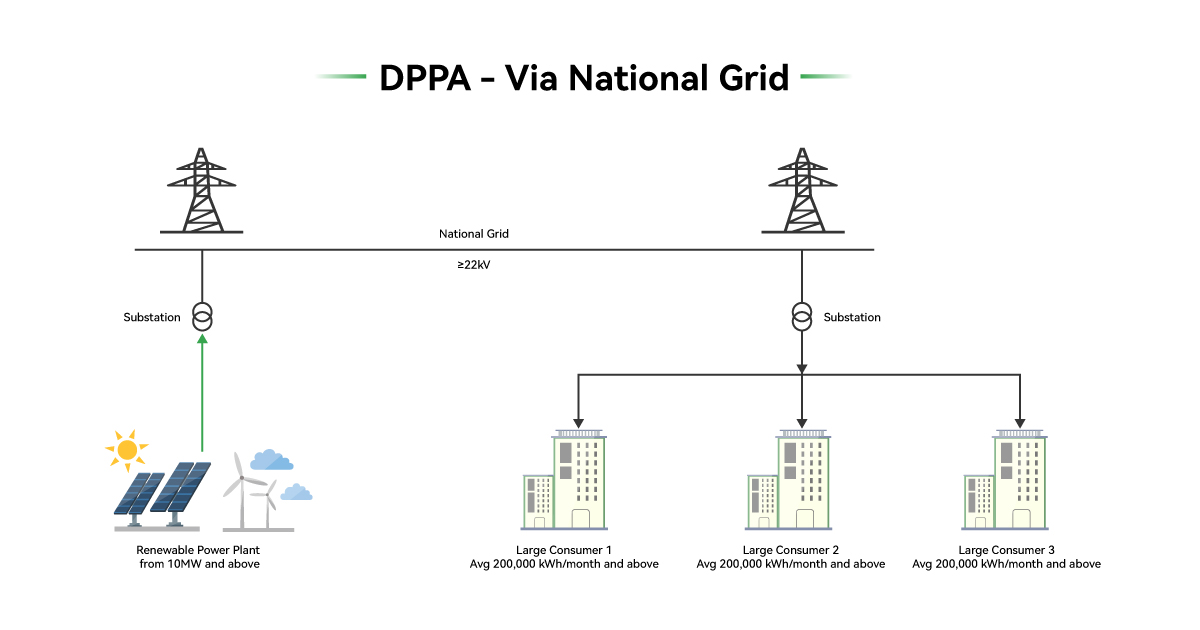
Under the Pilot Mechanism, the DPPA mechanism is implemented under the following financial DPPA model:
1. Renewable power generators will enter into a DPPA in the form of a fixed-term contract with electricity consumers, under which consumers guarantee that the power generator’s electricity price remains fixed (see 3), and in return, the power generator transfers the environmental attributes generated by the project to the consumers;
2. Although the term DPPA implies that the agreement involves the actual purchase and sale of electricity between the power generator and the customer, under the DPPA mechanism, the power generator does not physically deliver electricity to the customer; this is why this DPPA mechanism is referred to as a financial DPPA model. Instead, the power generator will sell all electricity to EVN on the competitive wholesale electricity market based on a standard power purchase agreement specified in the Draft Decision. The power company under EVN will sell electricity to customers at the retail electricity price. The electricity sold by EVN to customers does not necessarily have to be produced by the power generator’s project; and
3) Project Development – if a DPPA is negotiated and signed before the renewable energy project is constructed, the DPPA may need to address the following issues:
a) the deadline for the project’s commercial operation (Commercial Operation Deadline) and the remedies the customer may apply if the project has not achieved commercial operation by the Commercial Operation Deadline;
b) if the Commercial Operation Deadline is not met, the date by which the customer has the right to terminate the DPPA if the project continues to be delayed (Final Deadline);
c) the remedies available to the customer if the project achieves commercial operation but the plant’s capacity is lower than the agreed-upon capacity;
d) Extension of the Commercial Operation Deadline and the Final Deadline due to events beyond the power generator’s control.
4) Transfer of environmental attributes – how, when, and in what quantity will environmental attributes be transferred from the power generator to the customer?
5) Payment – What is the fixed price applied to a unit of electricity produced by the power generation unit? And what is the formula for calculating the payment one party must make to the other? In its simplest form, the formula might be as follows: For each payment cycle, the amount due is the quotient of (X) (i) the fixed price minus (ii) the price EVN pays the power generation unit for the electricity sold to EVN during that cycle, and (Y) the amount of electricity the power generation unit sold to EVN during that cycle.
6) Availability Commitment – a penalty that the customer may impose if the plant’s availability falls below the committed availability level;
7) Risk allocation in the event of changes in the law.