English
 Tiếng Việt
Decree No. 14/2021/ND-CP – A Major Shift in the Enforcement of Violations in Livestock Production and Animal Husbandry
1. Background and Rationale
On 16 June 2026, the Government issued Decree No. 211/2026/ND-CP on administrative penalties for violations in the livestock production sector. The Decree took effect on 5 August 2026 and replaced Decree No. 14/2021/ND-CP on administrative penalties for violations in the field of livestock production.
The new Decree aims to further improve the framework for administrative sanctions in this sector, based on the Law on Handling Administrative Violations and the amended Law on Animal Husbandry.
Compared with the previous regulations, Decree No. 211/2026/ND-CP further clarifies the scope of violations, applicable penalties, additional sanctions and remedial measures. Notably, the Decree covers not only livestock production but also matters relating to animal breeds, animal feed, livestock waste-treatment products, humane treatment of animals, and waste management in livestock production.
2. Increased and More Comprehensive Administrative Penalties
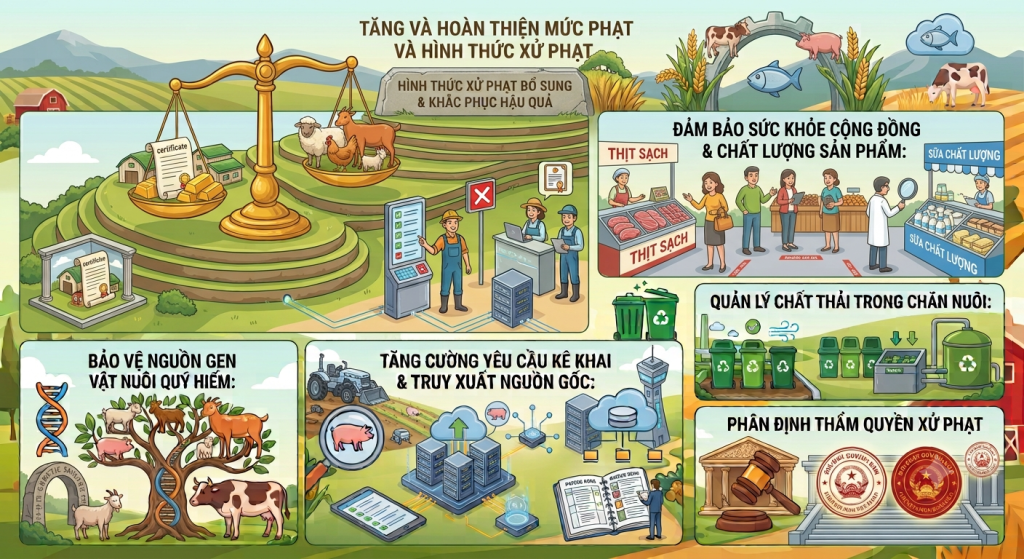
One of the notable features of Decree No. 211/2026/ND-CP is the clearer regulation of monetary penalties and enforcement authority.
For an individual committing an administrative violation in the livestock production sector, the maximum fine is VND 100 million. For an organization committing the same violation, the applicable fine is twice the fine imposed on an individual, meaning that the maximum fine may reach VND 200 million.
However, penalties are not applied uniformly to all violations. The applicable fine depends on the specific type and circumstances of each violation.
For example, in large-scale farm livestock production, failure to make the required livestock production declaration may result in a fine of VND 5–10 million. Fraudulent declarations for the purpose of obtaining an illicit benefit may be subject to a fine of VND 10–15 million, while conducting livestock production without the required Certificate of Eligibility for Livestock Production may result in a fine of VND 15–20 million.
In addition to monetary fines, the Decree provides for various additional sanctions and remedial measures. Depending on the violation, offenders may be subject to suspension of operations, revocation of certificates, or requirements to recall, destroy or change the intended use of non-compliant products.
3. Additional and More Specific Categories of Violations
Decree No. 211/2026/ND-CP establishes a relatively comprehensive framework of violations in the livestock production sector.
One notable area concerns the humane treatment of animals. Under Article 28, individuals who beat or cruelly mistreat animals may be subject to a fine of VND 1–3 million.
The Decree also introduces sanctions for violations occurring during the slaughtering process. Slaughterhouses may be penalized for beating animals before slaughter or failing to stun animals before slaughter.
In particular, acts such as introducing foreign objects, forcibly injecting water or introducing other substances into animals before slaughter are subject to different levels of penalties depending on the total weight of the animals involved. The maximum fine may reach VND 50 million for an individual.
In addition, the Decree provides specific regulations on the management and protection of animal genetic resources. Acts such as exploiting, trading, destroying, exporting or using newly discovered animal genetic resources before assessment and evaluation results are available, as well as damaging or appropriating animal genetic resources, may be subject to administrative penalties. For rare and precious animal genetic resources, the fine may reach VND 50 million for an individual.
4. Strengthened Requirements for Declarations, Records and Traceability
Another area receiving greater attention under the Decree is the responsibility of livestock establishments to maintain and manage information and records.
For large-scale livestock farms, establishments are required to retain and regularly update records concerning livestock production activities, the use of animal feed, veterinary medicines, vaccines and other relevant information to ensure traceability.
Failure to comply with these requirements or failure to maintain the prescribed safety distance for large-scale livestock production may result in a fine of VND 3–5 million. Separate penalties also apply to failure to make livestock production declarations or fraudulent declarations.
Accordingly, the Decree links the responsibility to maintain records and make declarations with the requirement to ensure the traceability of livestock production activities and products.
5. Strengthened Management of Livestock Waste
Decree No. 211/2026/ND-CP dedicates Article 29 to violations relating to livestock waste treatment. This demonstrates that waste management is treated as a separate category of administrative violations rather than merely as a secondary obligation in livestock production.
The waste-management provisions require livestock establishments to pay greater attention to the collection and treatment of waste generated from their operations. Compliance with waste-treatment requirements is intended not only to ensure lawful operation but also to reduce the environmental impacts of livestock production.
6. Allocation of Enforcement Authority
The Decree also specifies the administrative penalty powers of relevant authorities.
The Chairperson of the People’s Committee at commune level has the authority to impose fines of up to VND 50 million, while the Chairperson of the People’s Committee at provincial level may impose fines of up to VND 100 million.
The Decree further provides for the sanctioning authority of specialized officials and other competent authorities in the livestock production sector. Clear allocation of enforcement powers provides a legal basis for determining which authority is responsible for handling particular violations and ensures that sanctions are imposed within the scope of statutory authority.
7. Significance and Practical Implications
Decree No. 211/2026/ND-CP does more than simply revise the level of monetary penalties. It also expands and clarifies the system of administrative violations in the livestock production sector.
The provisions on humane treatment of animals, slaughtering practices, animal genetic resources, livestock declarations, traceability and waste treatment demonstrate a more comprehensive regulatory approach.
For businesses and livestock establishments, the Decree places greater emphasis on compliance with operational requirements, record-keeping, declarations and quality control.
For regulatory authorities, the provisions on enforcement powers provide a clearer legal basis for handling violations in accordance with their respective functions and statutory authority.
Overall, Decree No. 211/2026/ND-CP reflects a trend towards strengthening regulatory oversight and comprehensive compliance in livestock production, while combining monetary penalties with additional sanctions and remedial measures. This framework is expected to enhance the compliance responsibilities of organizations and individuals operating in the sector.
8. Recommendations for Organizations and Individuals
In light of the new regulations, businesses and livestock establishments should proactively review their operating conditions, certificates, declaration records and traceability documentation.
In particular, large-scale livestock farms should ensure that information relating to livestock production activities, animal feed, veterinary medicines and vaccines is properly retained and regularly updated in accordance with the regulations.
Establishments should also pay particular attention to humane treatment of animals, slaughtering requirements and livestock waste management. Proactively reviewing and improving internal compliance procedures can help reduce the risk of violations and the resulting administrative sanctions.
Conclusion
The key significance of Decree No. 211/2026/ND-CP lies in its replacement of Decree No. 14/2021/ND-CP and its further development of the system of administrative violations and sanctions in the livestock production sector.
The Decree places greater emphasis on humane treatment of animals, traceability, management of animal genetic resources and livestock waste, while establishing clearer rules on administrative penalties and enforcement authority.
For organizations and individuals operating in the livestock production sector, the new framework highlights the importance of proactive compliance, accurate record-keeping and effective internal controls.