English
 Tiếng Việt

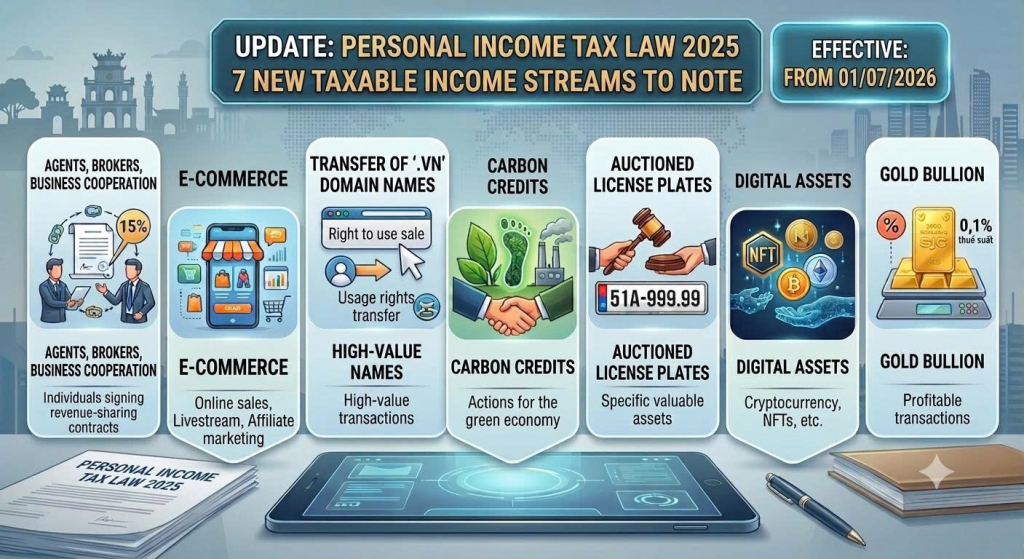
INDIVIDUALS SUBJECT TO 07 NEW CATEGORIES OF TAXABLE INCOME FROM 1 JULY 2026
The enactment of the Law on Personal Income Tax 2025 (Law No. 109/2025/QH15) officially replaces the Law on Personal Income Tax 2007 after nearly two decades in force. Effective from 1 July 2026, the new Law not only modernises and consolidates the existing legal framework but also significantly expands the tax base to capture emerging business models and new forms of income arising from the digital economy. Accordingly, taxpayers should pay particular attention to the seven new categories of taxable income introduced under Article 3 of the Law on Personal Income Tax 2025.
First, income derived from agency activities, brokerage services, and business cooperation arrangements with organisations is now expressly recognised as a separate category of taxable income. This provision primarily targets individuals acting as sales agents, commission-based brokers, or participants in business cooperation arrangements who, in practice, have often fallen outside the scope of effective tax declaration and administration.
Second, income generated from e-commerce activities and digital platform businesses will be subject to a more comprehensive tax administration regime. This amendment reflects the Government’s efforts to regulate the rapid expansion of online retail, livestream commerce, and affiliate marketing, sectors that have experienced substantial revenue growth but have historically lacked a sufficiently robust legal framework for effective tax collection, resulting in significant revenue leakage.
Third, income arising from the transfer of Vietnam’s national “.vn” Internet domain names is expressly included within the scope of taxable income. Given the increasing commercial value of domain name transactions and the absence of a clear taxation framework governing such transfers, this provision enhances the transparency and taxation of an important category of intangible digital assets.
Fourth, income derived from the transfer of greenhouse gas emission reduction results and carbon credits is recognised as taxable income for the first time. This represents a forward-looking legislative initiative supporting Vietnam’s commitment to achieving carbon neutrality while ensuring that economic gains generated from environmental assets are subject to taxation in a manner consistent with other forms of property and investment income.
Fifth, income from the transfer of vehicle registration numbers acquired through public auction has been added to the list of taxable income. This amendment reflects the growing secondary market for high-value registration numbers and ensures that profits realised from such transfers are subject to an appropriate tax regime consistent with the economic benefits derived from these transactions.
Sixth, the new Law takes a pioneering approach by bringing income derived from the transfer of digital assets within the scope of personal income tax. Although practical challenges remain in monitoring transactions involving digital assets, such as cryptocurrencies and non-fungible tokens (NFTs), the inclusion of these assets demonstrates Vietnam’s proactive approach to establishing a legal framework for taxation in the digital economy.
Seventh, income from the transfer of gold bullion is expected to be subject to personal income tax at a rate of 0.1% of the transfer value per transaction. The Government will issue detailed regulations specifying the taxable transaction threshold and the implementation roadmap in order to curb speculative activities, promote market stability, and avoid unnecessary disruption to ordinary retail gold transactions.
Overall, the expansion of the tax base under the Law on Personal Income Tax 2025 demonstrates Vietnam’s commitment to aligning its tax policy with the realities of the digital economy and emerging asset classes. At the same time, it reinforces the requirement for greater transparency in income reporting and financial transactions involving individuals generating income from these newly regulated sectors
Recommendations on Risk Management and Compliance for Individuals and Enterprises
To ensure compliance with the Law on Personal Income Tax 2025 and minimise the risks of administrative penalties, tax reassessments, or tax arrears upon its entry into force on 1 July 2026, individuals and income-paying organisations should consider implementing the following compliance measures.
1. Recommendations for Individuals
Maintain comprehensive transaction records
- Individuals should proactively retain contracts, invoices, bank statements, transaction histories from e-commerce platforms (including affiliate marketing and livestream sales), and all supporting documentation evidencing legitimate costs and expenses relating to transfers of domain names, vehicle registration numbers, gold bullion, carbon credits, and digital assets.
- Important: Failure to maintain adequate supporting documentation demonstrating acquisition costs or deductible expenses may result in the tax authority issuing a tax assessment based on the taxpayer’s entire transaction value or gross revenue.
Separate personal and business cash flows:
- Individuals engaged in commercial activities should establish and maintain dedicated bank accounts exclusively for business operations, including e-commerce activities, livestream sales, affiliate commissions, agency services, and brokerage income. Mixing personal and business funds may increase the risk that the tax authority treats all incoming funds as taxable income.
Proactively monitor legal developments and fulfil tax obligations
- Taxpayers should closely follow forthcoming Government Decrees and Ministerial Circulars providing detailed guidance, particularly in relation to the taxable thresholds applicable to gold bullion transfers and the tax administration regime governing digital asset transactions.
- Where taxable income arises, taxpayers should ensure timely tax registration, tax declaration, tax payment, and annual tax finalisation in accordance with the applicable statutory requirements.
2. Recommendations for Enterprises and Income-Paying Organisations
Review contractual arrangements and withholding obligations
Enterprises should conduct a comprehensive review of agency agreements, brokerage contracts, and business cooperation contracts (BCCs) entered into with individuals.
Particular attention should be paid to clearly allocating responsibilities for withholding personal income tax at source before making commission payments or distributing income to individuals, thereby mitigating the risk of subsequent tax reassessments, administrative penalties, or late payment interest imposed on the enterprise.
Upgrade information technology systems and reporting mechanisms
E-commerce platforms, digital platform operators, and affiliate marketing companies should upgrade their information technology infrastructure to enable the automated extraction of transaction and revenue data, facilitate tax withholding and declaration on behalf of sellers where required, and ensure compliance with electronic data connection requirements imposed by the tax authorities.
Standardise procedures for asset transfers and business cooperation
When acquiring domain names, carbon credits, or entering into business cooperation arrangements with individuals, enterprises should verify that the relevant personal income tax obligations have been fully discharged or, where required by law, withhold the applicable tax before making payment.
Overall, the expansion of the tax base under the Law on Personal Income Tax 2025 reflects Vietnam’s determination to keep pace with the rapid development of the digital economy and emerging forms of property and investment. At the same time, it underscores the increasing importance of financial transparency and tax compliance for individuals deriving income from these newly regulated activities.