English
 Tiếng Việt
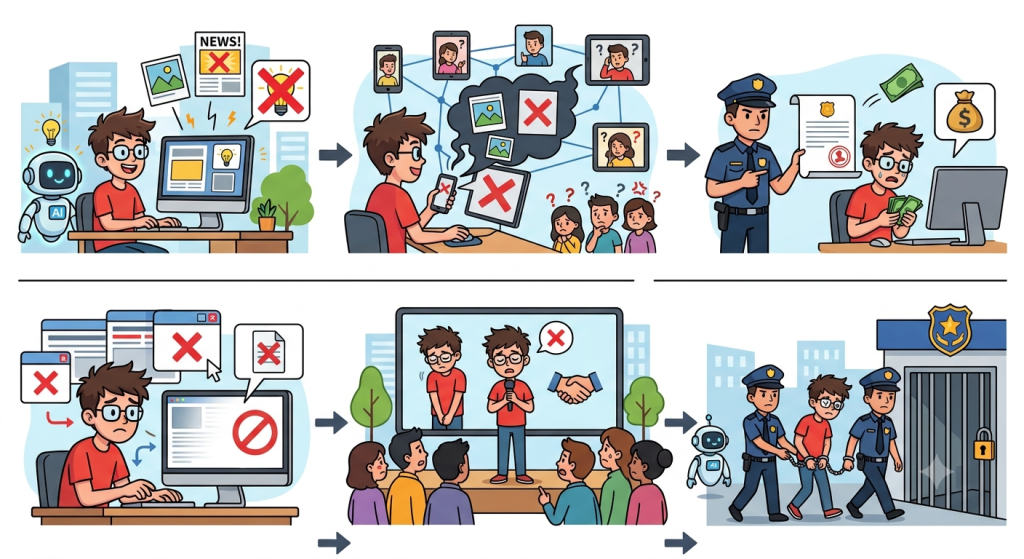
THE CONSEQUENCES OF USING AI TO CREATE AND SPREAD FAKE NEWS
As technology continues to develop rapidly, artificial intelligence (AI) is becoming a useful tool in education, work, and everyday life. However, along with its many benefits, AI can also be misused to create and spread fake or false information quickly and in increasingly sophisticated ways. Content such as deepfake videos, fake images, and AI-generated texts can make it difficult for people to tell what is real and what is not. As a result, such content can cause public confusion, damage a person’s or organization’s reputation, and even have negative effects on public safety and social order.
AI and Fake News from a Legal Perspective
In general, the law does not focus only on the technology being used. It also considers the actions of the person using that technology and the consequences of those actions. Therefore, using AI to create, edit, or spread false information online may still result in legal consequences if the action violates Vietnamese law.
Depending on the nature, seriousness, and consequences of the violation, a person may face administrative penalties or, in more serious cases, criminal responsibility under regulations related to cybersecurity, information technology, and other areas of law. This shows that AI cannot be used as a “shield” to avoid legal responsibility.
Administrative Penalties for Spreading False Information
Vietnamese law provides administrative penalties for people or organizations that use social media to provide or share fake information, false information, distorted content, or defamatory statements. The specific penalty depends on the nature and seriousness of the violation as well as the person or organization involved.
The applicable penalties may change over time. Under the regulations mentioned in Decree No. 15/2020/ND-CP, an organization that provides or shares fake or false information on social media may be fined from VND 10 million to VND 20 million. For individuals, the fine is generally half of the amount applied to organizations, ranging from VND 5 million to VND 10 million.
From July 1, 2026, under the new regulations mentioned in Decree No. 174/2026/ND-CP, the fine for an organization may increase to between VND 20 million and VND 30 million. Individuals may face fines ranging from VND 10 million to VND 15 million. These changes show that the law is becoming stricter in order to discourage the misuse of online platforms to spread false information.
More Than Just Fines: Other Possible Measures
In addition to financial penalties, violators may also be required to take other corrective measures, depending on the specific violation. One important measure is the removal of the offending content in order to limit the harm caused by fake or false information.
In certain cases, accounts, pages, or channels used to spread violating content may also be subject to appropriate measures under the law and the rules of the relevant online platform. If the violation is related to journalism or causes damage to a person’s or organization’s reputation, the person responsible may also be required to publish a correction, issue an apology, or take other corrective actions as required by law.
Serious Cases May Lead to Criminal Responsibility
Not every case of spreading fake or false information will result in criminal prosecution. However, if the act is particularly serious, causes major harm, or is carried out for purposes prohibited by criminal law, the person responsible may face criminal charges.
Depending on the content, purpose, and consequences of the act, several criminal offenses may be considered. These may include defamation, offenses involving the creation, possession, or distribution of information intended to oppose the State, or the abuse of freedom and democratic rights to harm the interests of the State or the lawful rights and interests of individuals and organizations.
Therefore, using AI to create and spread fake information is not simply a matter of “posting something online.” In serious cases, the legal consequences can go far beyond an administrative fine.
Advice for social media users
In the age of AI, everyone who uses social media should take responsibility for checking information before sharing it. Before reposting content that attracts a lot of attention or could have an impact on the public, users should check where the information came from, compare it with reliable and official sources, and be careful with unusual images, videos, or audio recordings.
In particular, people should not use AI to create, edit, or spread false information for the purpose of deceiving, insulting, defaming, or harming others. Technology can create content in just a few seconds, but the responsibility for that content still belongs to the person who uses the technology.
Another important issue is that digital data created and stored online can become important evidence during an investigation. Data messages, images, audio recordings, posting history, account information, and other forms of electronic data may be collected, examined, and assessed in accordance with laws on evidence and legal procedures. Therefore, deleting a post, image, or video after it has been shared does not necessarily mean that the violation will disappear completely. In many cases, related data may still remain on online systems, electronic devices, or other storage sources and can be used to help authorities identify and investigate the violation.
The online world may be virtual, but the actions people take and their legal consequences are real. Using AI responsibly, respecting the truth, and following the law can not only help individuals protect themselves but also contribute to building a healthy, safe, and trustworthy information environment.